
Betting Exchange Commission: How Much Do You Pay?
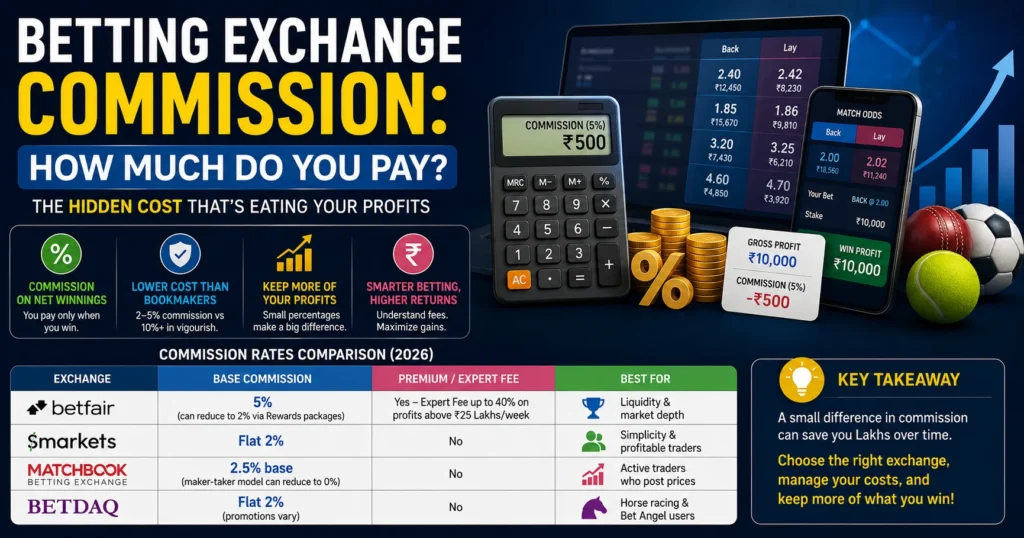
The Hidden Cost That’s Eating Your Profits
You’ve done your research. You’ve found better odds than any traditional bookmaker could offer. You’ve placed your bet, it’s landed, and you’re counting your winnings. Then the exchange takes its cut.
That moment—the one where you realise your profit isn’t quite what you expected—is when most Indian punters start asking the same question: how much am I really paying in betting exchange commission?
Here’s the truth: betting exchanges commission are still significantly cheaper than traditional bookmakers. A sportsbook builds its margin into the odds—typically around 10% or more in vigourish—while exchanges charge just 2–5% commission on net winnings. But if you don’t understand the fine print, that “small” percentage can cost you far more than you think.
Let’s break down exactly what you’re paying, compare the major exchanges side by side, and—most importantly—show you how to keep more of your money in your pocket.
Table of Contents
How Betting Exchange Commission Actually Works
Before we compare rates, let’s get one thing straight: betting exchange commission is only charged on net winnings, not on your total stake.
If you back a horse at 6.0 (5/1) with a ₹1,000 stake and it wins, your profit is ₹5,000. At a 5% commission rate, the exchange takes ₹250, leaving you with ₹4,750. That’s still typically more than a sportsbook paying 9/2 would offer.
This “commission on net winnings” model is what makes exchanges so attractive. Unlike bookmakers that take their cut regardless of whether you win or lose, exchanges only profit when you do. Lose your bet? You pay nothing in commission.
But there’s a catch: betting exchange commission is calculated per market, not per bet. If you place multiple bets on the same cricket match and some win while others lose, your net profit across all bets determines your commission liability for that market.
The 2026 Commission Landscape: Who Charges What?
| Exchange | Base Commission | Premium/Expert Fee | Best For |
|---|---|---|---|
| Betfair | 5% (can reduce to 2% via Rewards packages) | Yes—Expert Fee up to 40% on profits above ₹25 Lakhs/week | Liquidity & market depth |
| Smarkets | Flat 2% | No | Simplicity & profitable traders |
| Matchbook | 2.5% base (maker-taker model can reduce to 0%) | No | Active traders who post prices |
| Betdaq | Flat 2% (promotions vary) | No | Horse racing & Bet Angel users |
Betfair: The Market Leader with a Price Tag
Betfair is the undisputed giant of betting exchanges. Its liquidity is unparalleled—for major events like IPL or international cricket, you can get large sums matched instantly. But that convenience comes at a cost.
The standard commission rate is 5% for most Indian customers accessing the international exchange. However, Betfair offers a tiered Rewards structure where customers can pay 8%, 5%, or 2% depending on their chosen package.
The real sting, though, is the Expert Fee (formerly known as the Premium Charge). Introduced in January 2025, this additional levy hits consistently profitable accounts. You’ll pay it if:
- Your lifetime account is in profit
- Your gross profit over the last 52 active weeks exceeds ₹25 Lakhs
- You’ve bet in more than 100 markets
The rates? 20% on profit between ₹25 Lakhs–₹1 Crore and 40% above ₹1 Crore—minus commission already paid that week. Most Indian traders never reach these thresholds, but if you’re a serious punter betting on high-volume cricket tournaments, this can dramatically impact your bottom line.
Smarkets: The Flat-Fee Alternative
If simplicity is your priority, Smarkets offers a compelling alternative. Their flat 2% betting exchange commission on net winnings is refreshingly straightforward. There’s no premium charge, no complex tier system, and no nasty surprises.
For profitable traders, Smarkets can work out significantly cheaper than Betfair. The trade-off? Lower liquidity. Large bets often can’t be fully matched, and in-play liquidity is especially thin during off-peak hours for Indian users. But for football traders and those looking to avoid Betfair’s premium charges, it’s an increasingly popular choice among savvy Indian bettors.
Matchbook: The Trader’s Exchange
Matchbook operates a maker-taker model that rewards active traders. Here’s how it works:
- Makers (traders who post prices) pay 0% commission
- Takers (traders who accept prices) pay approximately 1.5–2% depending on their volume tier
The base rate is 2.5%, but the volume-based discounts can make this the cheapest option for high-frequency traders. Matchbook also has no premium charge, making it attractive for long-term winners.
The downside? Liquidity is significantly below Betfair, and horse racing can be thin outside major meetings. Third-party trading software also has limited native support.
Betdaq: The Horse Racing Specialist
Betdaq offers a flat 2% betting exchange commission with frequent promotions—sometimes even 0% on certain markets. It has the strongest liquidity among Betfair’s alternatives, particularly for UK and Irish horse racing, which many Indian punters follow.
For Bet Angel users, this is especially relevant: Bet Angel supports Betdaq natively. The variable commission structure (historically 2–5%) makes profitability calculations less predictable, but the occasional 0% promotions make it excellent for testing strategies.
What the 2–5% Range Actually Means for Your Wallet
Let’s put these percentages into perspective with real numbers in Indian Rupees.
Suppose you place 100 winning bets over a year, each generating ₹10,000 in profit. That’s ₹10,00,000 (10 Lakhs) in gross winnings. Here’s what you’d pay in commission:
| Commission Rate | Annual Commission | Net Profit |
|---|---|---|
| 2% | ₹20,000 | ₹9,80,000 |
| 5% | ₹50,000 | ₹9,50,000 |
| 5% + 20% Expert Fee (on ₹10 Lakh profit) | ₹50,000 + ₹1,90,000 = ₹2,40,000 | ₹7,60,000 |
That’s a difference of ₹2,20,000 between the cheapest and most expensive option. Over several years, that gap widens into lakhs of rupees.
And remember—this example assumes you’re below the Expert Fee threshold. If you’re a consistently profitable trader generating ₹30 Lakhs+ annually, the gap becomes even more pronounced.
Hidden Costs You Might Be Overlooking
1. Per-Market Commission Calculation
Commission is calculated per market, not per bet. If you place multiple bets on the same IPL match and some win while others lose, your net profit across all bets determines your commission liability.
This can work in your favour (losses offset winners) or against you (if you win big on one bet and lose small on others, you still pay commission on the net profit).
2. The “Implied Commission” Trap
Some exchanges, particularly Betfair, use an “implied commission” calculation for their premium charges. This means you’re charged commission on both winning and losing markets—a percentage of your losses is treated as “implied commission”. For high-volume traders, this can significantly increase the effective commission rate.
3. Currency and Regional Variations
Betting exchange commission rates can vary by region. Indian customers accessing the .com or .uk exchanges typically pay different rates than Australian or US customers. Always check the rates for your specific location and the domain you’re using.
4. Deposit and Withdrawal Fees
While not strictly “commission,” these fees eat into your profits. Some exchanges charge for certain payment methods like international wire transfers or crypto conversions. Factor these into your overall cost calculations—especially since INR deposits often involve forex conversion charges.
How to Reduce Your Betting Exchange Commission
1. Choose the Right Exchange for Your Strategy
- Casual bettor? Smarkets’ flat 2% is simple and cost-effective.
- High-volume trader? Matchbook’s maker-taker model could get you to 0%.
- Horse racing specialist? Betdaq’s 2% with occasional 0% promotions is compelling.
- Need maximum liquidity for IPL? Betfair’s 5% might be worth it—but watch out for the Expert Fee.
2. Take Advantage of Volume Discounts
Most exchanges offer reduced rates for high-volume traders. Betfair’s Rewards packages can bring commission down from 5% to 2%. Matchbook’s volume tiers can reduce your rate to as low as 0%. If you’re placing significant volume, these discounts add up quickly.
3. Post Prices (Be a Maker)
On Matchbook, posting prices (being a “maker”) means you pay 0% commission. The catch? Your bet might not get matched immediately. But if you’re patient and strategic, this can eliminate commission entirely.
4. Use Multiple Exchanges
No single exchange is best for everything. Use Betfair for liquidity during big cricket matches, Smarkets for simplicity, and Matchbook or Betdaq for lower commission on specific markets. Shopping around can save you significant money.
5. Account for Commission in Your Calculations
Always subtract expected commission (2–5%) when calculating your potential profit and sizing lay stakes. This prevents unpleasant surprises and ensures your strategy remains profitable.
6. Use Commission Calculators
Tools like the Hedge Calculator can factor in exchange commission to show your true profit or loss. Many matched betting exchange calculators also include commission fields—make sure you’re using ones that allow you to input percentages.
The Bottom Line: What Should You Pay?
Here’s the honest truth: you shouldn’t be paying 5% commission in 2026.
With Smarkets offering a flat 2%, Betdaq matching that rate, and Matchbook offering 0% for makers, the days of accepting 5% as “standard” are over. If you’re paying 5% on Betfair without a Rewards discount, you’re leaving money on the table.
But—and this is a big but—liquidity matters. The best commission rate in the world is useless if your bets don’t get matched. Betfair’s 5% might be worth paying if you need to get large sums matched instantly on major events like the IPL final or an India-Pakistan match.
The smart approach? Use multiple exchanges. Keep a Betfair account for liquidity when you need it. Use Smarkets or Betdaq for your day-to-day betting where lower commission makes a real difference. And if you’re an active trader, explore Matchbook’s maker-taker model.
Final Verdict
Betting exchange commission isn’t complicated—but it’s easy to overpay if you don’t pay attention. The range is 2–5% on net winnings, with additional charges like Betfair’s Expert Fee for consistently profitable accounts.
| Your Profile | Recommended Exchange | Expected Commission |
|---|---|---|
| Casual bettor | Smarkets | 2% flat |
| High-volume trader | Matchbook (maker) | 0% |
| Horse racing specialist | Betdaq | 2% (with promotions) |
| Maximum liquidity needed (IPL/Intl. Cricket) | Betfair (with Rewards) | 2–5% |
The key takeaway? Don’t just accept the default rate. Explore your options, take advantage of volume discounts, and—most importantly—factor commission into every bet you place.
Because in the end, it’s not about how much you win. It’s about how much you keep.
Disclaimer: Commission rates and structures are subject to change. Always verify current rates on the exchange’s official website before placing bets. Gambling can be addictive—please bet responsibly. This guide is for informational purposes only and does not constitute financial or legal advice. Ensure you comply with local laws in India regarding online betting.