
Back and Lay Betting Explained: How Betting Exchanges Really Work
Introduction
If you have ever placed a bet with a traditional bookmaker, you are familiar with one side of the story—you bet on something happening. But what if you could bet against something happening? What if you could play the role of the bookmaker yourself?
Welcome to the world of betting exchanges.
In this complete guide, we will break down back and lay betting explained in the simplest way possible. Whether you are a cricket fan looking to bet on the IPL or someone exploring smarter ways to wager, this guide will show you how betting exchanges work, how to calculate your profits, and why Indian bettors are increasingly turning to exchanges over traditional bookmakers.
Table of Contents
What Is a Betting Exchange?
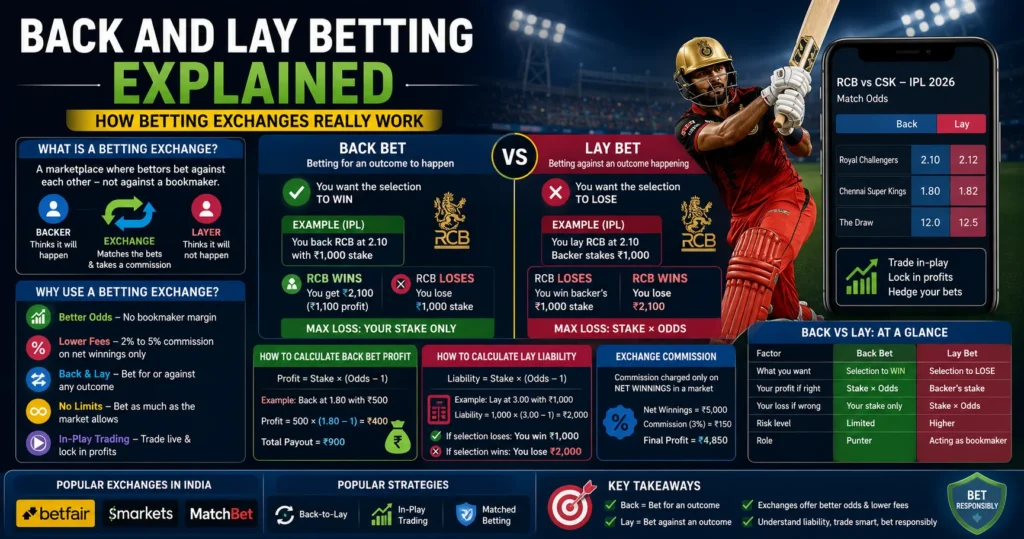
A betting exchange is a marketplace where bettors bet against each other instead of against a bookmaker. Think of it like a stock exchange—but for sports betting.
| Title | Traditional Bookmaker | Betting Exchange |
|---|---|---|
| Who you bet against | The bookmaker (house) | Other bettors (peer-to-peer) |
| Odds set by | Bookmaker’s oddsmakers | Bettors themselves (market-driven) |
| How platform makes money | Built-in margin in odds | Commission on net winnings |
| Can you lay bets? | No | Yes |
At its core, a back and lay betting explained exchange is simply a bet between two people. One person thinks an outcome will happen (the backer), and another person thinks it will not happen (the layer). The exchange matches these two bets and takes a small commission from the winner.
Back Betting Explained
Back and lay betting explained: Backing means betting for an outcome to happen. This is exactly what you do when you place a bet with a traditional bookmaker.
How Back Betting Works
- You bet that a team, player, or selection will win
- If they win, you get your stake multiplied by the odds
- If they lose, you lose only your stake
Example: During an IPL match, you back Royal Challengers Bangalore at odds of 2.10 with INR 1,000.
- If RCB wins: You get INR 1,000 × 2.10 = INR 2,100 (INR 1,100 profit)
- If RCB loses: You lose your INR 1,000 stake
Your maximum loss is limited to your stake—nothing more.
Lay Betting Explained
Back and lay betting explained: Laying means betting against an outcome happening. This is where betting exchanges truly shine. When you lay a bet, you are essentially playing the role of the bookmaker.
How Lay Betting Works
- You bet that a team, player, or selection will NOT win
- If they lose, you win the backer’s stake
- If they win, you pay out the backer’s stake × odds
Example: You lay Royal Challengers Bangalore at odds of 2.10. A backer stakes INR 1,000 on them to win.
- If RCB loses: You win the backer’s INR 1,000 stake
- If RCB wins: You lose INR 1,000 × 2.10 = INR 2,100 (the backer gets their INR 2,100 payout)
Your maximum loss on a lay bet is your stake multiplied by the odds—this can be significantly more than your stake.
Back vs Lay: The Key Difference at a Glance
| Back Bet | Lay Bet | |
|---|---|---|
| What you want | The selection to WIN | The selection to LOSE |
| Your profit if right | Stake × Odds | Backer’s stake |
| Your loss if wrong | Your stake only | Stake × Odds |
| Risk level | Limited (stake only) | Higher (stake × odds) |
Why Use a Betting Exchange?
1. Better Odds
Bookmakers build a margin (overround) into their odds to guarantee profit. Exchanges don’t do this—odds are set by bettors, leading to better value.
2. Lower Fees
Traditional bookmakers take their cut through inflated odds. Exchanges charge a transparent commission—typically 2% to 5%—only on your net winnings. If you lose, you pay nothing.
3. Play Both Sides
You can back and lay the same event, allowing you to trade positions just like in financial markets.
4. No Limits
Bookmakers often restrict bettors who win too much. Exchanges don’t—if someone is willing to take the other side of your bet, you can bet as much as you want.
5. In-Play Trading
You can bet during live events and trade in real-time to lock in profits or cut losses.
How to Calculate Back Bet Profits (INR)
The formula is simple:
Profit = Stake × (Odds − 1)
Example: You back India to win a Test match at odds of 1.80 with INR 500.
- Profit = 500 × (1.80 − 1) = 500 × 0.80 = INR 400
- Total payout = 500 + 400 = INR 900
How to Calculate Lay Bet Liability (INR)
This is the crucial part—knowing your maximum loss before placing a lay bet:
Liability = Stake × (Odds − 1)
Example: You lay a football team at odds of 3.00 with a backer’s stake of INR 1,000.
- Liability = 1,000 × (3.00 − 1) = 1,000 × 2 = INR 2,000
- If the team loses: You win INR 1,000
- If the team wins: You lose INR 2,000
Understanding Exchange Commission
Betting exchanges charge commission only on your net winnings in a market. Here is how it works:
Net winnings = Total winnings − Total losses (in a market)
If you win INR 5,000 in a market and the commission rate is 3%, you pay:
- Commission = 5,000 × 3% = INR 150
- Final profit = 5,000 − 150 = INR 4,850
Popular back and lay betting explained exchange like Betfair typically charge between 2% and 5% commission, while Smarkets is known for its low commission rates.
Trading Strategy: Back-to-Lay
Back and lay betting explained: One of the most popular strategies on betting exchanges is the back-to-lay trade. Here is how it works:
- Back a selection at higher odds
- Wait for the odds to shorten (as more people back the same selection)
- Lay the same selection at the lower odds
- Lock in a guaranteed profit regardless of the outcome
IPL Example:
- You back Mumbai Indians to win at odds of 4.00 with INR 1,000
- Mumbai Indians start playing well, odds drop to 2.50
- You lay Mumbai Indians at 2.50 with liability calculated to guarantee profit
- No matter who wins, you make a profit
This is similar to buying low and selling high in the stock market.
Matched Betting: Risk-Free Profits
Matched betting involves placing a back bet with a bookmaker (often using a free bet) and placing the opposite lay bet on an exchange. This covers all outcomes and locks in profit from the free bet.
This technique has become popular among Indian bettors looking to extract value from bookmaker promotions.
Cricket Betting on Exchanges
Back and lay betting explained: Cricket—especially the IPL—is the most popular sport for betting exchanges in India. You can:
- Back a team to win the match or tournament
- Lay a team (bet against them)
- Trade during live matches as odds fluctuate
- Hedge your positions to lock in profits
Many Indian bettors are now choosing exchanges over traditional bookmakers for cricket betting because of the better odds, flexibility, and the ability to lay bets.
Betting Exchanges in India
Back and lay betting explained: Several betting exchanges accept Indian bettors and support transactions in Indian Rupees (INR). Popular platforms include:
- Betfair — The world’s largest betting exchange
- Smarkets — Known for low commission rates
- MatchBet — Locally popular in India
Most platforms support Indian payment methods like UPI, bank transfers, and Paytm.
Pros and Cons of Betting Exchanges
Back and lay betting explained Pros and Cons
Pros:
- Better odds and better value
- Lower fees than bookmakers
- Ability to lay bets (bet against outcomes)
- No limits on winning bettors
- In-play trading and hedging opportunities
Cons:
- Lower liquidity in some markets (fewer bettors to match with)
- More complex than traditional bookmakers
- Higher risk on lay bets (liability can be large)
- Not available in all regions
Key Takeaways
- Back betting = betting for an outcome (like traditional betting)
- Lay betting = betting against an outcome (playing the bookmaker)
- Betting exchanges connect backers and layers directly
- Better odds are available on exchanges due to no built-in bookmaker margin
- Commission is charged only on net winnings (typically 2-5%)
- Back-to-lay trading allows you to lock in profits regardless of the outcome
- Cricket and IPL are the most popular markets for Indian exchange bettors
Final Thoughts
Back and lay betting explained opens up a whole new world of possibilities. Instead of being limited to betting for outcomes like with traditional bookmakers, you can now bet against them too. You can trade during live events, hedge your positions, and access better odds.
Whether you are betting on the IPL, international cricket, football, or tennis, understanding how to use both back and lay bets gives you a significant advantage. Start small, understand your liability on lay bets, and gradually explore trading strategies like back-to-lay.
The betting exchange model is growing in India, and those who understand it early will have the edge.
Disclaimer: This article is for educational purposes only. Betting involves financial risk. Please bet responsibly and ensure you comply with all applicable laws in your jurisdiction.